Review of Air Waybill, Maritime Chokepoints, the OPIOIDS Project & Digital Corridors in Asia-Pacific

Airfreight: FIATA Calls for Review of IATA Direct Air Waybill Changes
On 28 May, FIATA called for a formal review of the proposed changes to the Direct Air Waybill (DAWB) framework adopted at the recent International Air Transport Association (IATA) Cargo Agency Conference (CAC), invoking the IATA-FIATA Consultative Council (IFCC) review mechanism under IATA CAC Resolution 801c, Article 4.2.
The measures adopted by the CAC introduce significant changes to the allocation of responsibilities, liabilities and indemnities among airlines, freight forwarders and shippers in relation to the use of DAWBs. Following extensive consultations with stakeholders worldwide, FIATA identified important legal, operational and insurance considerations, as well as growing uncertainty regarding the practical implementation of the new framework. The review request seeks to provide an opportunity for a structured industry-wide reassessment of the adopted measures before the scheduled expedited date of effectiveness of 1 July 2026, recognising that changes of this magnitude require further assessment to ensure they are operationally workable, legally clear and appropriately aligned with the roles, responsibilities and risks of the various stakeholders involved.
FIATA remains committed to constructive engagement with IATA, airlines and all industry stakeholders to support the development of balanced and operationally workable solutions that address legitimate industry considerations while reinforcing clarity, legal certainty and resilience across the global air cargo system.
International Trade: High-Level Dialogue Among Senior Executives at the WTO

At a high-level meeting hosted by the World Trade Organization (WTO) on 28 May, Director-General Ngozi Okonjo-Iweala convened senior executives from the world's leading shipping lines and logistics groups, who painted a sobering picture of the pressures bearing down on global trade. With disruptions concentrated in the Gulf region and other key chokepoints, carriers are being forced to seek alternative routes, a process that is pushing up costs across transport networks and, ultimately, for consumers. Representatives warned that capacity constraints are tightening across both maritime and land-based corridors, with some alternative ports and rail connections already saturated. The scale of the challenge was thrown into sharp relief by one executive's observation that it takes approximately 70 freight trains to replicate the carrying capacity of a single container ship. Against this backdrop, participants called for greater public-private cooperation, accelerated implementation of the WTO Trade Facilitation Agreement, and sustained investment in port and logistics infrastructure worldwide to safeguard the predictability and efficiency upon which global supply chains depend.
During the meeting, FIATA, represented by its Director General, Dr Stéphane Graber, called for strengthened risk management and contingency planning, including the early identification of vulnerable routes and the preparation of alternative solutions. These efforts require closer international cooperation, both among public authorities and across the industry, notably between shipping lines and freight forwarders. He also highlighted the need to review contractual frameworks, particularly provisions on force majeure, deviations, and exceptional costs, as well as to enhance the monitoring of insurance and political risks. For more information please see the FIATA legal and Insurance briefing note on the Middle East security situation.
He recalled in particular the operational challenges for freight forwarders arising from shipping lines measures such as discharging cargo at alternative ports or declaring an “End of Voyage,” which can require rerouting shipments through other modes of transport. This reflects a broader shift: the priority is no longer solely to preserve the original maritime route, but rather to ensure the continuous movement of cargo despite disruptions.
While investment in diversification remains critical, it was noted that resilience is increasingly becoming a key criterion for future transport infrastructure investments. This includes expanding maritime capacity, developing alternative routes, and, importantly, strengthening multimodal corridor solutions. Overall, this evolution underscores a transition from a purely maritime perspective to an integrated supply chain approach, in which freight forwarders play a central role.
In this context, support from customs authorities, ports, and operational bodies, combined with streamlined procedures and clear communication channels, can significantly enhance the ability of supply chains to adapt effectively in times of crisis.
Maritime: Choke Points Under Pressure - What Maritime Strait Disruptions Mean for Freight
FIATA Director General, Dr Stéphane Graber, was invited to discuss the growing vulnerabilities of the world's strategic maritime straits on Géopolitis, a geopolitics programme broadcast by the Swiss channel RTS. The conversation covered the economic, logistical, and geopolitical stakes of disruptions to key chokepoints, from the Strait of Hormuz to the Malacca Strait and the Bosphorus, and what these mean for global supply chains.
Dr Graber described the current environment as a succession of shocks, from the Covid-19 pandemic and the grounding of the Evergreen, to Red Sea attacks and renewed tensions around Hormuz, where unpredictability has become the new normal. Each disruption forces freight forwarders to rapidly activate alternative routes, at considerable cost: rerouting via the Cape of Good Hope adds up to 20 extra days at sea, increases fuel consumption by 30–50%, and generates around 60% more CO₂.
It is in these moments that the indispensable role of freight forwarders comes into sharp focus. As the architects of continuity, they swiftly recalibrate logistics networks to keep cargo moving when trade routes are compromised. In a world where supply chain resilience has become a strategic priority, freight forwarders are not a supporting function, they are a frontline one.
The conversation also highlighted cyber risk and piracy as major disruptors in their own right — capable of paralysing supply chain nodes within hours or endangering crews and cargo at sea. Addressing these threats demands training and education: a well-trained, prepared logistics professional is better equipped to recognise early warning signs and act decisively when an incident occurs, minimising disruption and maintaining operational continuity.
Dr Graber also drew attention to the often-overlooked human dimension of these crises. Seafarers, civilians operating under prolonged stress, with limited ability to be relieved of duty, bear a burden that deserves far greater recognition. Dr Graber expressed his deep gratitude for their dedication and professionalism, without which global trade could not function.
Click here to view the full episode!
Region Asia-Pacific: Strengthening Digital Corridors and Regional Connectivity in Tianjin
FIATA's Members from the Region Asia-Pacific (RAP) will meet with the United Nations Economic and Social Commission for Asia and the Pacific (UNESCAP) in a dedicated session at the 2026 FIATA-RAP Field Meeting taking place 2-4 June in Tianjin, China. The event, co-hosted by China International Freight Forwarders Association (CIFA), will bring together intergovernmental expertise and industry perspective on the region's most pressing transport and logistics challenges.
The session, titled "Rethinking Global Logistics: Building Digital Corridor Development & Connecting Infrastructure" will open with Mr Fedor Kormilitsyn, Economic Affairs Officer, Transport Division, UNESCAP, followed by FIATA to share their respective priorities and ongoing projects, before selected RAP delegates present their logistics and transport projects and initiatives.
Topics on the table span the full breadth of regional logistics development — from multimodal corridor connectivity and cross-border facilitation, to the digitalisation of transport documents.
The session reflects FIATA's continued commitment to engaging with UN bodies to ensure that the voice of freight forwarders and logistics operators informs policy frameworks that shape trade across Asia-Pacific.
Register here for the 2026 FIATA-RAP Field Meeting
Safety & Security: INCB Updates Lists of Substances with No Known Legitimate Uses

The International Narcotics Control Board (INCB) has issued updates to its lists of substances identified as having no known legitimate medical or industrial uses, as part of its Global Operational Partnerships to Interdict Opioids' Illicit Distribution and Sales (OPIOIDS) Project. These lists serve as practical tools to inform Governments, investigators, frontline officers and industry partners, and to support efforts to counter the manufacture, marketing, movement and monetisation of the substances concerned.
The recent update expands the list of fentanyl-related substances (FRS) to 183 substances, the list of synthetic non-fentanyl opioids (NoFOs) to 101 substances, and the list of novel benzodiazepines to 51 substances. In addition, in April 2026 the Board established a new list of 55 ketamine and phencyclidine (PCP) related substances with no recognised legitimate uses.
The INCB invites all relevant Government authorities and, through them, industry partners to refrain on a voluntary basis from any manufacture, marketing, import, export or distribution of the substances on the lists, beyond limited research and analytical purposes. Where Governments identify any legitimate medical or industrial application of these substances, the Board encourages them to share all relevant information with the INCB so that the lists remain accurate and up to date.
For freight forwarders, awareness of these lists supports due diligence in the movement of goods and helps prevent the misuse of supply chains for the trafficking of illicit substances. FIATA encourages its Members to familiarise themselves with the updated lists and to share them with the relevant teams within their organisations.
The lists are publicly available on the INCB website:
- Fentanyl-Related Substances list
- Synthetic Non-Fentanyl Opioids list
- Benzodiazepines list
- Ketamine and PCP-Related Substances list
Source: International Narcotics Control Board (INCB)
Access the official communication from INCB here
Multimodal Transport & Trade Facilitation: FIATA to Join ESCAP Regional Workshop on the UN Convention on Negotiable Cargo Documents

FIATA will participate in the upcoming United Nations Economic and Social Commission for Asia and the Pacific (ESCAP) Regional Capacity-Building Workshop on "The Convention on Negotiable Cargo Documents and its benefits for Strengthening Transport Connectivity for Landlocked Developing Countries in Asia", taking place in Almaty, Kazakhstan, and online on 17 June 2026.
Organised by the ESCAP Transport Division, the workshop will examine how the United Nations Convention on Negotiable Cargo Documents (NCD) can support multimodal transport development and improve trade connectivity for landlocked developing countries across the Asia-Pacific region.
FIATA Legal Services Director, Ms Andrea Tang, will participate as a speaker, contributing the operational perspective of freight forwarders. The programme will explore the practical application of NCDs across modes of transport, including a dedicated session featuring the annotated FIATA Multimodal Bill of Lading (FBL) as one of two key industry initiatives presented. Further sessions will address lessons learnt from paper and electronic NCD pilot projects, country priorities in multimodal transport, and the role of multimodal transport corridors in facilitating regional trade.
The Convention establishes a uniform legal framework for the issuance and use of negotiable cargo documents across all modes of transport, extending an instrument previously confined to maritime transport into multimodal and land-based operations. This is particularly significant for landlocked developing countries, as it strengthens the competitiveness of land and multimodal transport corridors, facilitates access to trade finance, and supports integration into global supply chains.
The workshop will be held in person and online, on a self-financing basis, with English and Russian simultaneous interpretation. Registration is open until 1 June 2026. Participants also have the option to attend the "SIPA Regional Dialogue on Policy Implementation for Sustainable and Resilient Freight Connectivity in Central and Southeast Asia", jointly organised by ESCAP and the International Transport Forum (ITF) on 18 June 2026 in Almaty, back-to-back with the workshop.
FIATA encourages its Members in the Asia-Pacific region, in particular those active in multimodal and land transport operations, to take part in this important capacity-building initiative.
Register for the Workshop here
Click here for more information on the workshop
Upcoming FIATA Events
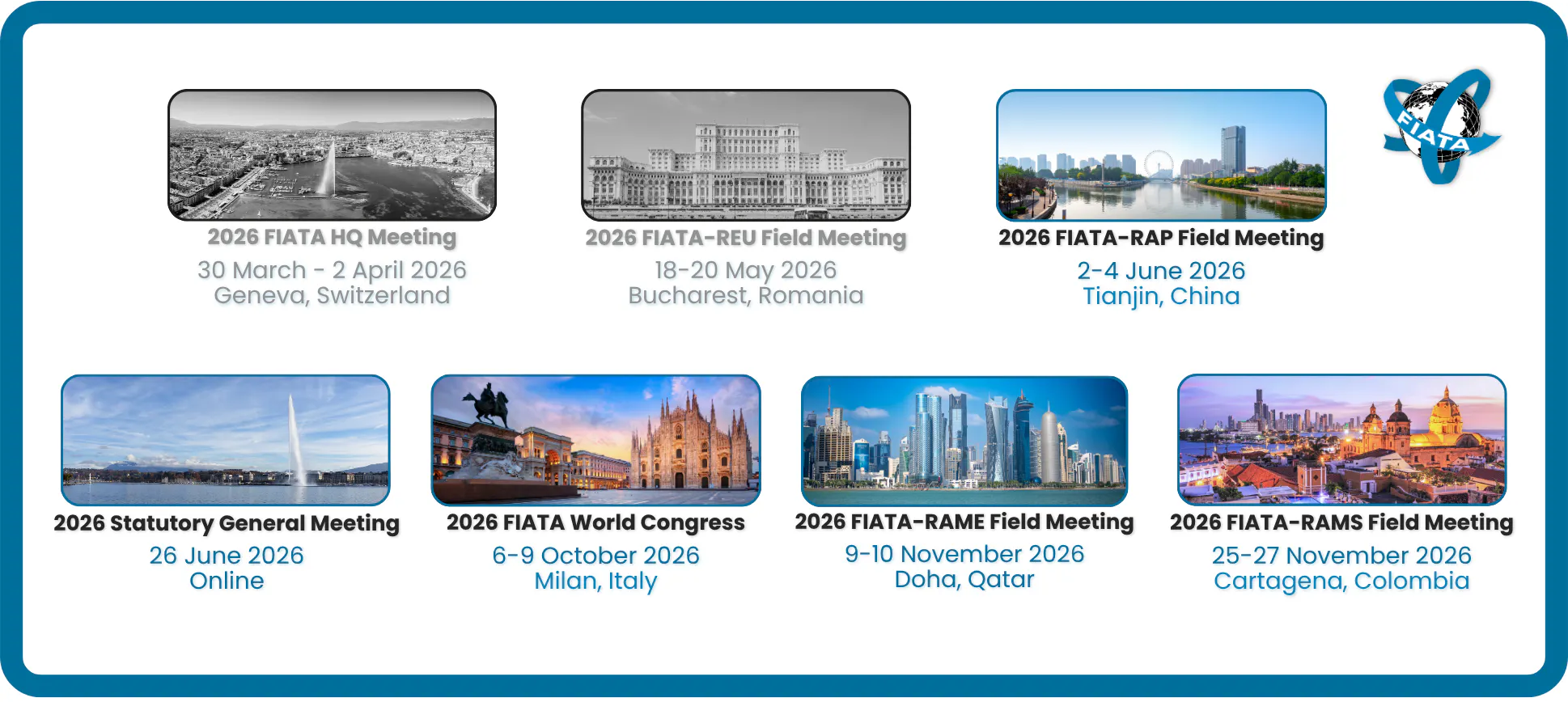
- 2026 FIATA-Region Asia-Pacific Field Meeting, Tianjin, China: 2-4 June 2026
- 2026 Statutory General Meeting, Online: 26 June 2026
- 2026 FIATA World Congress, Milan, Italy: 6-9 October 2026
- 2026 FIATA-Region Africa and the Middle East Field Meeting, Doha, Qatar: 9-10 November 2026
- 2026 FIATA-Region Americas Field Meeting, Cartagena, Colombia: 25-27 November 2026