Managing Maritime Risk, Advancing eBLs and Upcoming Events

Maritime: Free Webinar - Managing Risks in Maritime Contracting
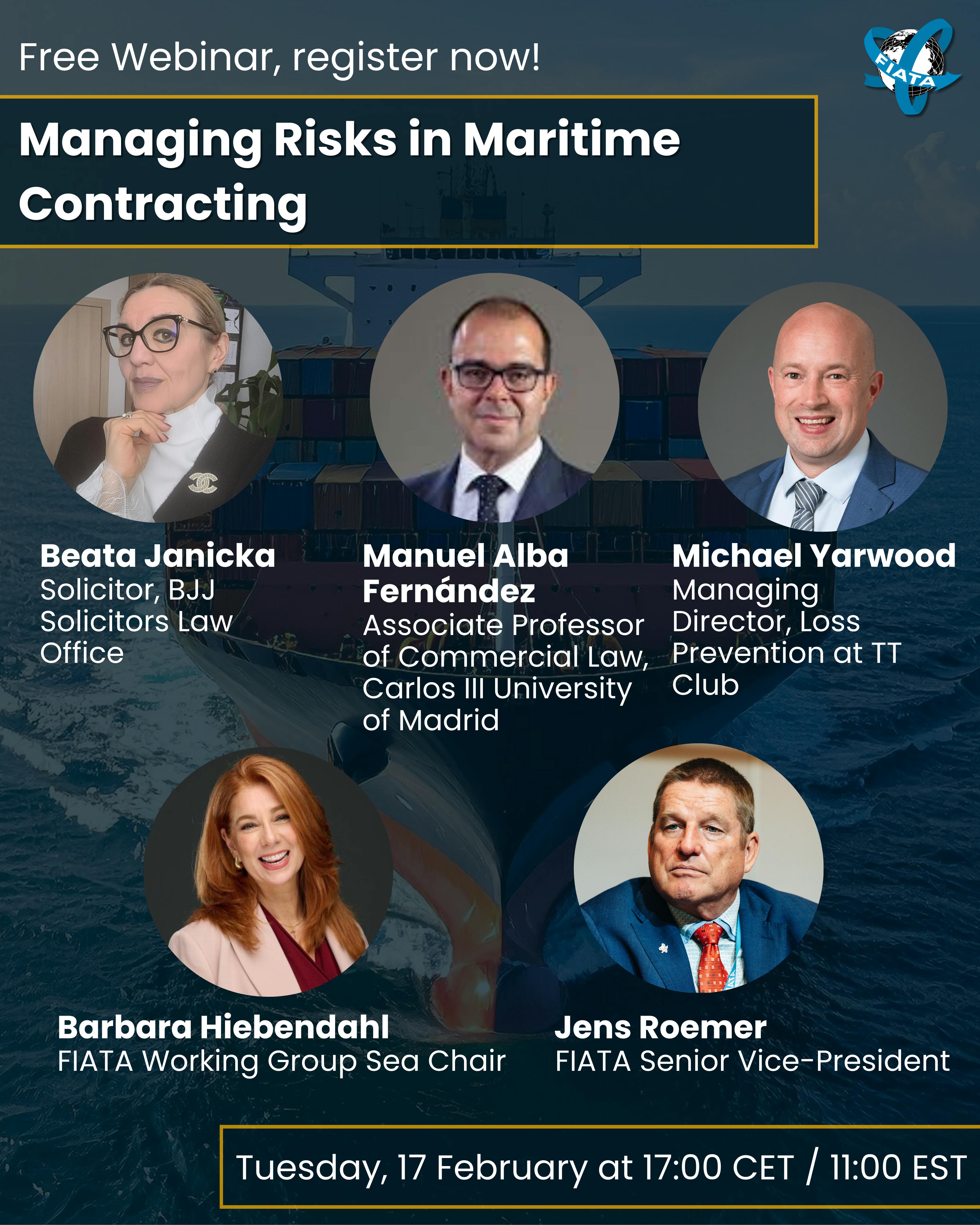
On Tuesday, 17 February at 17:00 CET / 11:00 EST, FIATA will host a free 1 hour 15 minute webinar on "Managing Risks in Maritime Contracting", bringing together legal and industry experts to address one of the most pressing areas for freight forwarders today.
As responsibilities expand across the transport chain, maritime contracts sit at the heart of operational and financial exposure. The way liability is defined, transferred and managed can directly affect performance, client relationships and long-term credibility. A more deliberate approach to contractual risk is becoming essential.
This session will explore the freight forwarder’s expanding responsibilities, providing practical insight into critical clauses, frequent exposure points, and recurring challenges in ocean carrier agreements. Participants will also have the opportunity to exchange views, encouraging greater consistency and awareness across the industry.
The webinar will feature:
- Ms Beata Janicka, Solicitor, BJJ Solicitors Law Office
- Mr Manuel Alba Fernández, Associate Professor of Commercial Law, Carlos III University of Madrid
- Mr Michael S Yarwood, Managing Director, Loss Prevention at TT Club
- Ms Barbara Hiebendahl, FIATA Working Group Sea Chair
- Mr Jens Roemer, FIATA Senior Vice-President
Participants are encouraged to consult FIATA’s Best Practice Guide on Maritime Contracting – Risk Management and the Role of the Contractual Carrier.
2026 FIATA HQ Meeting: Registration and Visa Deadline Reminder
The 2026 FIATA HQ Meeting, taking place 30 March-2 April, in Geneva, Switzerland, will once again bring together the global freight forwarding community for a focused week of dialogue, coordination and strategic exchange.
As FIATA advances its centenary objectives and ongoing policy priorities, this gathering provides Members with the opportunity to engage directly in shaping the Federation’s work across key technical, legal and industry domains.
The programme will feature dedicated sessions addressing current developments in transport, digitalisation, sustainability and trade facilitation. For Association Members, Individual Members and stakeholders alike, the FIATA HQ Meeting remains a vital forum to share expertise, strengthen collaboration and ensure that regional perspectives are reflected at international level.
Participants are encouraged to complete their registration as soon as possible. With the visa issuance deadline approaching, early confirmation is particularly important for those requiring entry visas to avoid administrative delays. Please note that visa letters will not be provided to anyone registering after Friday, 27 February 2026.
FIATA looks forward to welcoming its Members for a productive and forward-looking week of engagement. Further details, including registration information and practical guidance, are available on the official event page.
International Trade and Law: Safeguarding Freight Forwarders’ Interests in UNCITRAL’s Digital Transformation Work
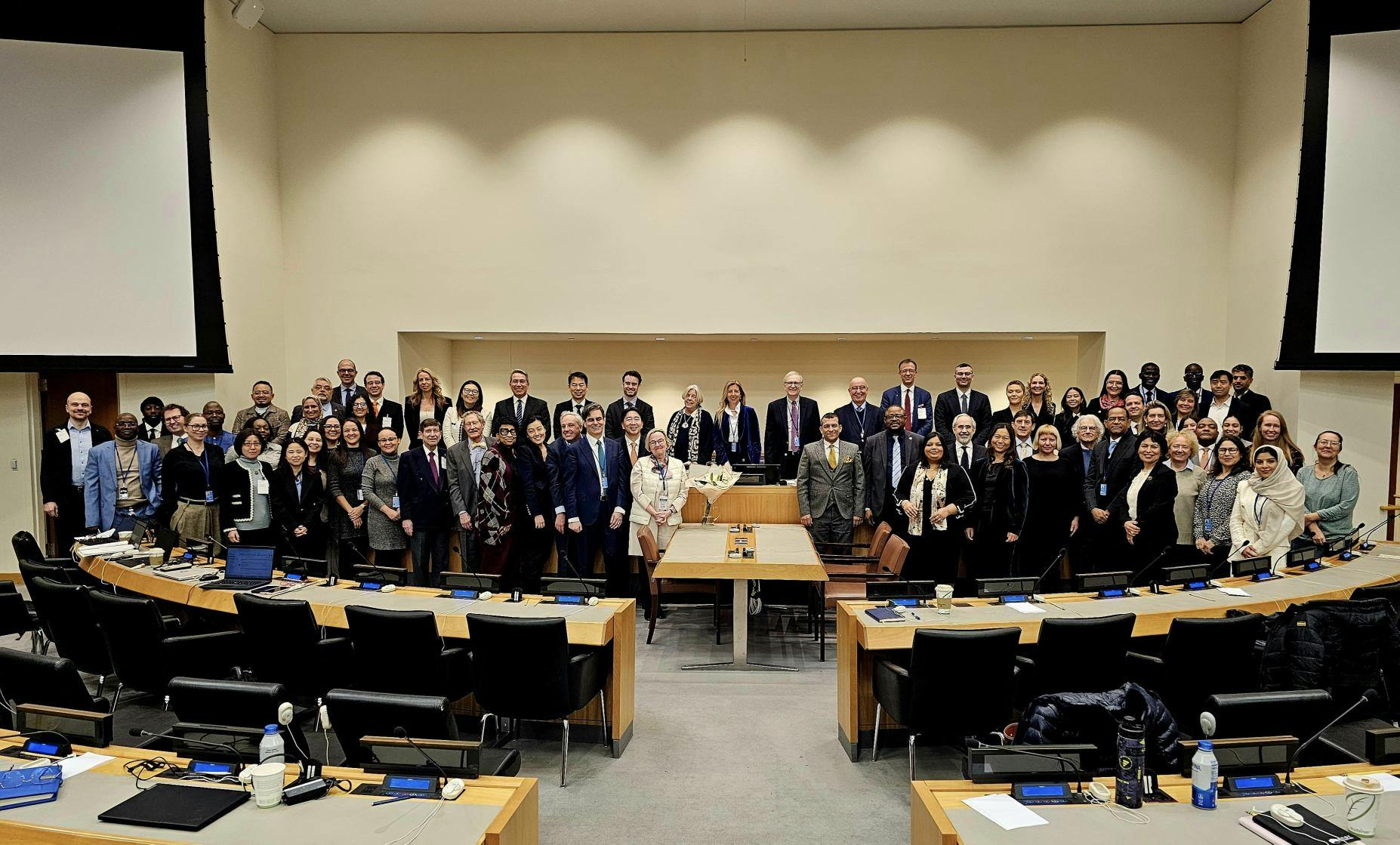
From 10 to 13 February 2026, the United Nations Commission on International Trade Law (UNCITRAL) held a four‑day Colloquium at the UN Headquarters in New York on “Harmonizing law in the age of digital trade and finance – digital assets and platforms”. Convened under a mandate from UNCITRAL’s 58th session, the Colloquium advanced exploratory work on secured transactions involving new types of digital assets and on the private‑law dimensions of digital platforms.
Bringing together governments, international organisations, academia and the private sector, the Colloquium fostered cross‑sector dialogue on legal concepts shaping the future digital trade ecosystem. In light of FIATA’s strong collaboration with UNCITRAL, most notably on the new Convention on Negotiable Cargo Documents (NCD), FIATA was invited to present the business case for its digital, negotiable Multimodal Transport Bill of Lading (eFBL) and to share reflections on the evolving role of platforms.
Discussions were structured around two thematic streams. The first addressed the use of digital assets in secured financing, including legal classification, third‑party effectiveness, enforcement and cross‑border conflict‑of‑law challenges. The second focused on digital platforms and private law, examining contractual relationships, platform governance and the balance of rights and obligations between platforms and users. The outcomes will inform UNCITRAL’s ongoing work and be reported to the Commission in 2026.
FIATA Director General, Dr Stéphane Graber, presented the case study of the eFBL on a panel addressing “Digital platforms for transactions and asset‑based registries” and participated in a panel on solutions for end‑to‑end trade digitalisation and interoperability.
While recognising the intermediary role of platforms as core transactional infrastructure in global trade—and the broad diversity of B2B platforms, discussions highlighted common concerns. These included increasingly quasi‑regulatory functions that move away from standard law, limited transparency, asymmetries between platform operators and users, and custodial dependency. With fewer than 4% of Bills of Lading currently issued digitally worldwide, the need for standardised terms supporting interoperability, clear data‑governance principles and procedural fairness remains critical.
FIATA will continue to work closely with UNCITRAL to support balanced standard legal frameworks and to protect the interests of freight forwarders and platform users in the evolving digital trade environment, including the protection of data ownership for shippers and freight forwarders. For more information, please consult the FIATA–GSF Charter for Protection and Governance of Data in International Trade, which sets out minimum arrangements for data security and confidentiality that operators of digital booking and trading platforms should adopt.
Digitalisation: ISO 5909 Advancing Electronic Bills of Lading for Global Logistics

The publication of (ISO) 5909:2026, created jointly by International Organization for Standardization and United Nations Centre for Trade Facilitation and Electronic Business (UN/CEFACT) marks a significant development for electronic bills of lading (eBLs). This international standard defines the processes, data structures and lifecycle elements needed to issue, transfer and manage eBLs on digital platforms with integrity and consistency. It establishes a common reference point for interoperability across carriers, banks, customs authorities and logistics service providers. More details on the standard are available from ISO’s official page.
Its relevance is closely linked to the legal progress achieved through the United Nations Commission on International Trade Law (UNCITRAL) Model Law on Electronic Transferable Records (MLETR), which enables electronic transferable documents to carry the same legal effect as their paper equivalents in jurisdictions that have adopted aligned legislation. While MLETR provides the legal foundation for recognising electronic bills of lading, ISO 5909 delivers the technical and operational framework necessary for their consistent implementation. Together, they strengthen both the legal certainty and the practical usability of eBLs in cross-border trade.
For freight forwarders and the wider logistics community, ISO 5909 offers clarity where variation has previously hindered broader adoption of electronic documentation. By harmonising business processes and data semantics, it supports the efficient exchange of information and strengthens confidence in digital trade workflows. This can contribute to smoother cargo release, clearer audit trails and improved interaction with digital trade finance mechanisms.
FIATA will continue to monitor updates and developments related to eBL standards and implementation, with a view to supporting Members as the industry transitions from paper-based bills of lading to digital alternatives.
2026 FIATA-RAME Field Meeting: Building Resilient and Sustainable Supply Chains in a Digital RAME
On 11 and 12 May 2026, FIATA will bring the Region Africa and the Middle East (RAME) community together in Doha, Qatar, for the 2026 FIATA-RAME Field Meeting, hosted by the Qatar Association of Freight and Logistics (QAFL). The event will convene freight forwarders, logistics service providers, policymakers and regulators from across the region for two days of strategic dialogue and high-level networking.
Qatar’s growing role as a regional logistics hub makes it a fitting host for this year’s meeting. Supported by advanced infrastructure, strong air and maritime connectivity, and a business oriented environment, Doha offers a dynamic setting to address the evolving needs of supply chains across the region.
Under the theme “Building Resilient and Sustainable Supply Chains in a Digital RAME”, the programme will explore:
- regulatory developments;
- trade facilitation;
- digital transformation;
- artificial intelligence;
- evolving transport solutions.
Discussions will focus on strengthening operational resilience, sustainability and long-term competitiveness across the region.
The 2026 FIATA-RAME Field Meeting offers an excellent platform to exchange insights, develop partnerships and contribute to shaping the future of supply chains in the Region Africa and the Middle East.
Upcoming FIATA Events
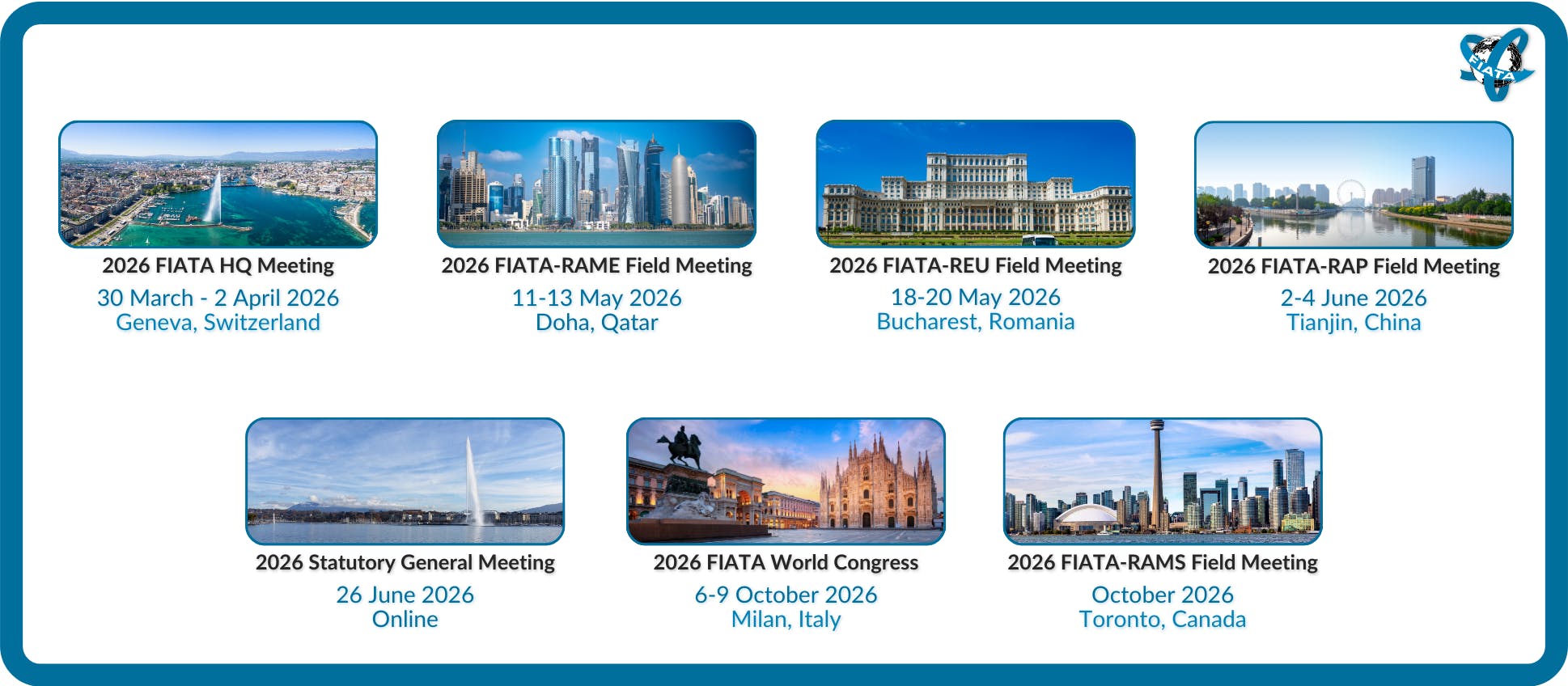
- 2026 FIATA HQ Meeting, Geneva, Switzerland: 30 March - 2 April 2026
- 2026 FIATA-Region Africa and the Middle East Field Meeting, Doha, Qatar: 11-12 May 2026
- 2026 FIATA-Region Europe Field Meeting, Bucharest, Romania: 18 - 20 May 2026
- 2026 FIATA-Region Asia-Pacific Field Meeting, Tianjin, China: 2 - 4 June 2026
- 2026 Statutory General Meeting, Online: 26 June 2026
- 2026 FIATA World Congress, Milan, Italy: 6-9 October 2026
- 2026 FIATA-Region Americas Field Meeting, Toronto, Canada: October 2026